Wednesday, April 15, 2009

Brazilian Waxing Before And After Shots

Ultrasound

MYRIAM DE LAMBERT
Place memory study: The uterus

Work undertaken as part of a residence at Avatar, Quebec

Work "Ultrasound" Myriam Lambert Myriam Lambert from we Vimeo.


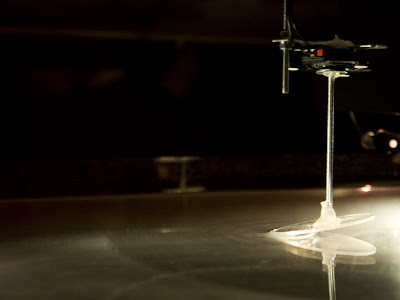
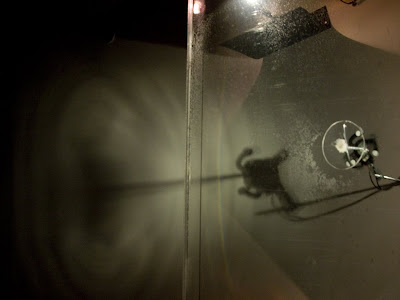
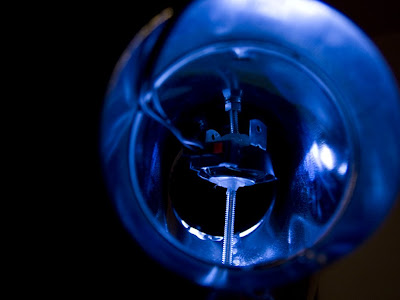
In the room where the darkness is almost complete, a speaker suspended emits a complex tangle of organic sounds, beats the heart of adults and children, breathing and bowel sounds. A screw glued to the speaker absorbs sound vibrations, and these are transmitted to a canister of water suspended a few inches of the audio device. As one hears the sounds, the waves give a circular motion to the screw, causing a myriad of paths in the water. These oscillations then take liquids architectural dimensions and invade the venue for their bright ideas. Soon, the viewer understands that the sound frequencies are causing undulations of light present on the walls, ceiling and floor. Ultrasound leaves an impression of "already felt" like when we were in the womb of our mother.
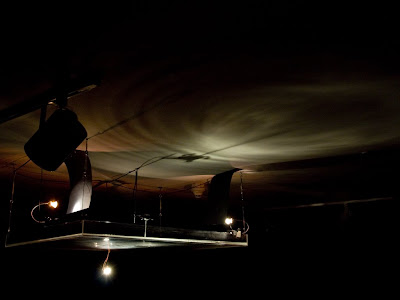


An analogy between this work and the medium of photography is obvious: the sound waves become negative, the cartridge of water becomes an enlarger, and walls, meanwhile, used paper. The fingerprint is then transformed into photographic memory of a place. Multiple refractions of this work are the mirror images and sounds that make up the primordial environment of the fetus. Although it was developed using new technologies, this facility purified transcends technique and direct challenge of sensations already experienced by all, transmuting our relationship to the world in a poetic experience.
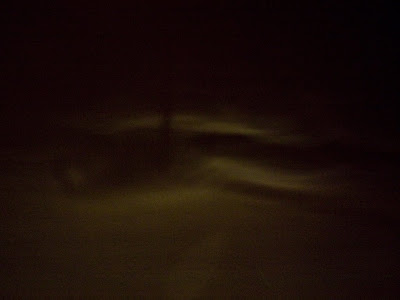

Ultrasound reminds the viewer / listener experiences his very first video and audio in the womb. We absolutely must remember a moment so that the latter has marked our body memory? This immersive installation was developed on the concept of sensory memory, emphasizing the fact that the body is the main entrance of all variations of memory: auditory, visual, group, location, etc.. According
Pernoud (2007: 12), it appears that "it is between five and half months and six months that can locate the early reactions to auditory stimulation [a fetus]. " His heartbeat and those of his mother, and the sounds of landslides, breaths and rumblings are an integral part of its acoustic environment. This sensitive atmosphere immerses the listener into a quiet typing.

Although it's a time to initiation of the most fundamental of our lives, it is removed from our "slide" of memories. Sensory memory is the only reference we have of that moment. Moreover, Ultrasound is also a reflection of a collective memory: the work presents us with common roots that are the basis of identity.

***
PERNOUD, Laurence, (2007), I am expecting a child, Paris, Editions Horay, 476 p.

------------------------------------------------ ----------------------------------------------

This work was conducted as part of a residency at AVATAR association creation and dissemination in electronic and sound arts. Thank Mériol Lehmann, Jocelyn Robert, Amanda Gauthier and Marie-Christine Desbiens AVATAR and Genevieve Mom, Dad Michael, baby Alexander, Manon mom, dad and baby Stephen Joseph for the audio recording of the child's heart.


Friday, February 13, 2009

Creative Fingers Tech Deck

SEEDLING TREES OF WOOD

  • Substrate:
cuttings during the rooting phase are susceptible to decay caused by fungi, therefore the substrate must t be sterile. For proper formation are roots and reduce the risk of infection, the substrate must be well ventilated. The substrate must maintain a level of moisture and good drainage const ant:


  • - In an open place, with an automatic misting system, we must use 100% perlite. There are nurseries that use 20% 80% perlite and peat without problems. This depent good management conditions in the greenhouse for rooting.
  • - Indoors or misting is manual, the substrate should hold more water, have to use 50% peat and 50% perlite, sand or vermiculite. One can even use 100% sand.
Mixtures proposed :
  • - 1 / 9 of peat and 8 / 9 perlite.
  • - 2 / 3 yellow sand and 1 / 3 always rbe blonde.
  • - 1 / 3 vermiculite and 2 / 3 of p erlite on a layer of sand .
turbe,bouturage fibres,noix de coco,plant
The Peat
coconut fibers
substrate temperatures:
  • - The substrate temperature should p have come down below 18 ° C, 20 ° C is optimum.
  • Humidity:
For that cuttings do not dry, moisture from the air must be very high (90-100%) and wet the substrate well. In an open place:
  • - can reduce the number of leaf cuttings to reduce the transpiration rate.
  • - can uti Liser a misting system or use an automatic misting system temperate 05 to 10 seconds of mist every 15 to 20 minutes is sufficient .
  • - misting stops for the night.
Indoors:
  • - can make by fogging construction emissions cuttings:
- 1 to 2 times per day - 1-2 times a week.
  • Temp érature:
To prevent wilting of the cuttings temperature range is between 24 to 27 ° C. during the day. The 15 ° C overnight is accepted.
  • cuttings s:
The presence of a timber yard is needed to control and maintain the health of trees. The trees from which cuttings are taken must be aged a minimum of 4 years or early production period. features branches to choose:
  • - Twigs from trees free of all diseases and pre-tested for their quality and variety performance.
  • - twigs 6 to 12 months 25 to 30 cm.
  • - Twigs sufficiently hardened off without being very woody.
  • - The branches have a certain succulence.
  • - The branches of the outside.
  • - The herbaceous shoots that break at 90 ° bends.
  • - The fall harvest is better than the spring (178 to 186 days before flowering):
  • - strong cambial activity period: early spring and late autumn.
  • - twigs taken from trees well watered and well fed
Preparation of cuttings:
  • - Disinfect areas and slides.
  • - The time period between sampling branches and the establishment of the cuttings must be at least 36 hours.
  • - The branches take the cuttings from 10 to 15 cm in length.
  • - Cut just below the basal node and 1 cm above the bud.
  • - Keep 2 to Four upper leaves on the cuttings.
  • Hormone:
AIB liquid:
  • - The solution of the AIB should be stored away from light because the infra-red and ultra-violet can alter.
  • - Use of hormone concentrations from 4000 to 6000 ppm with soaking time from May to October seconds.
  • - Dip cuttings 2-3 cm deep.
AIB powder:
  • - Use powder 1% of the AIB
  • Placing cuttings:
  • - Indoors disinfect the place of planting (grass cuttings) 24 h before transplanting.
  • - Treat the cuttings with 3% bleach if the rate of decay after planting is important.
  • - Working out of direct sunlight to prevent wilting of the cuttings and degradation of the hormone (AIB)
  • Treat the base of the cuttings with alcohol or fungicide.
  • - Softwood cuttings should be planted quickly and can be stored semi-hardwood cuttings a few hours in a humid place.
  • - Put the cuttings 3-5 cm deep.
  • - Put cuttings from 400 to 1000 per sqm depending on the media cuttings (bin, shelf trays, blister).
bouturage,semi ligneux,olivier enracinement,olivier,plant,boutures
semi-wood cuttings of olive
Rooting

Tuesday, November 4, 2008

How Long Does It Take Dickies To Dry

WATER, REFLECTION AND RESONANCE / CURRENT

Work on the influence of the St. Laurent Quebec identity,
on Quebec's collective memory.

Presentation artist centers Regart and Wagon itinerant art in the North-South project, at the AKI art 4.

Inspired by the heritage and history of Quebec, the work WATER, REFLECTION AND RESONANCE connects the image and the word, place and identity. This work is an artistic presentation of historical and cultural evolution of Quebec society.


WATER, AND REFLECTION OF RESONANCE
MYRIAM LAMBERT


Project WATER, REFLECTION AND RESONANCE exposure consists of 12 photographs, along with some texts. I associated current photographs and updating photographs of events that took place in Quebec near the St. Lawrence River, and has been since the beginning of colonization. These images are accompanied by poems composed from contemporary writings the time of Champlain. The aim was to present a reflection on the evolving identities of the Quebec population in connection with the St. Lawrence. This work has two components: the image and word.


Research has been done in the Archives of the City of Quebec and the Quebec National Archives to select photographs and engravings dating from the previous four centuries, depicting life riverside. With these images, I created new works by assigning new textures, a contemporary as well as transforming their colorimetry. These techniques allow me to create a space of representation wondering about Quebec's identity and cultural heritage. I then linked these new images depicting a contemporary event that helps build a sense of belonging to Quebec in connection with the St. Lawrence.


Contextualization of this part of the work on the upper decks of two Quebec-Levis Ferry provides an opportunity for viewers to question the origin of each photograph and offered him food for thought about the evolution of Quebec society.

Also, I have written poems inspired by some writings dating from the time of Champlain. These texts present the river as the foundation of the Quebec identity. The texts of the era, also exposed, are juxtaposed with new ones so that the public can compare the old French and modern French. So I want to mention the importance of the French in America and its survival almost miraculous 400 years.

The venue occupies a big part of my artistic process. Quebec-Levis ferry seemed a suitable choice for broadcast WATER, REFLECTION AND RESONANCE they sail in the heart of the main subject of the exhibition. As part of strengthening the sense of belonging to Quebec, the St. Lawrence played a leading role during colonization. Transport, fishing and supply water were needed for the survival of early settlers. They identified with the St. Lawrence through needs it filled. Now, the needs are filled in different ways, the river system remains indispensable for most Quebecers and Canadians. However, the contact with the river is less direct than it was before. The reasons why people identify with today have been processed and we could speak here of identification with her beauty and activities that surround it. Quebec-Levis ferry are the ideal places to present this demonstration exposure, because after 400 years of history, these boats are the places where the relationship between the river and the citizen is the most direct and poetic.

In collaboration with the Quebec Ferries.

This project is possible thanks to the contribution of the Conseil des arts et des lettres du Québec.


Detail of "Raft River Batiscan" (photography), 1942.
Library and Archives Nationales du Quebec, Ministry of Fond
Evironnement and Wildlife. E57, S44, SS1, PB54-48.


Detail of "Third centenary of Quebec" (copy negative)
[ca 1908]. Archives of the City of Quebec, N00900.


Details of "Ice cream" (photography), 1937.
City Archives of Quebec, N016353.


Detail of "Quebec - The central bay up the river"
(copy negative), 1917. Archives of the City of Quebec, N021505.


Detail of "Quebec - Place d'armes" (negative) [18 -].
Fund Board Planning and Conservation
Archives of Quebec City, N021685.